In modern agriculture, achieving high productivity and resource efficiency is impossible without automated irrigation systems. Centre-pivot (circular) irrigation systems are increasingly preferred, especially for large-scale arable land. In this article, we will discuss the structure of centre-pivot irrigation systems, the types of fields they are suitable for, their real advantages, and maintenance guidelines. As Sulama MMC, we have implemented dozens of such projects in Azerbaijan, basing our insights solely on practical experience.
Knowing the key aspects of selecting and operating centre-pivot irrigation systems is crucial for maximising yield and resource efficiency.
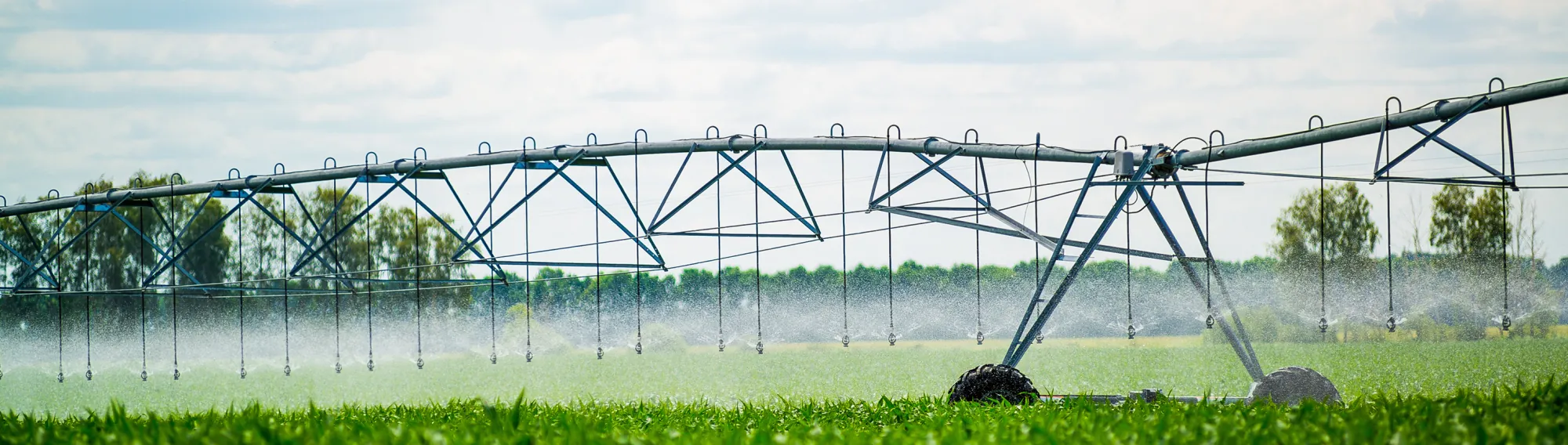
A centre-pivot irrigation system is an automated installation consisting of a long pipe and sprinklers mounted on special supports. The central point (pivot) remains fixed, while the entire line of pipes and sprinklers rotates around this point, irrigating the field in a circular pattern.
The pipe length typically ranges from 100 to 800 metres, allowing a single unit to cover up to 50–60 hectares. Water is supplied mainly from the central tower and distributed evenly along the entire length. The system is operated automatically, with many models offering remote monitoring and programming capabilities.
Important: The size and capacity of the system must be professionally calculated. At Sulama MMC, we take a comprehensive approach, considering field size, soil characteristics, crop type, and water source capacity.
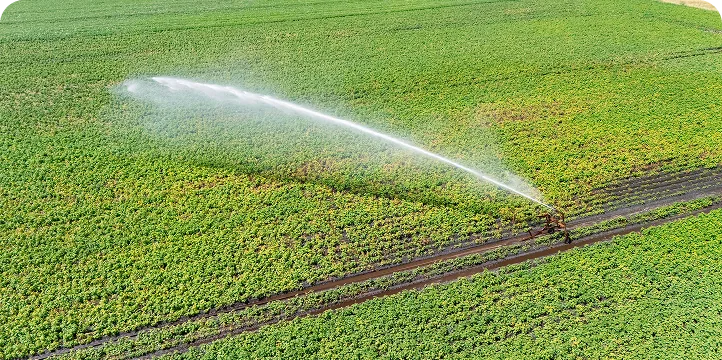
Centre-pivot irrigation systems deliver the best results on large, unobstructed fields of 20–200 hectares that are relatively flat and free from significant obstacles (such as forest belts, power lines, or roads). On large farms, these systems are most commonly used for the following crops:
Centre-pivot systems are not efficient for small, narrow, or irregularly shaped fields, or where there are many utility lines. In such cases, stationary or linear (frontal) irrigation systems are more appropriate.
The main advantages are high productivity and minimal manual labour. A single centre-pivot unit can provide uniform irrigation for 50–60 hectares per day.
For large farms, this simplifies crop planning and reduces dependence on weather fluctuations. A common mistake is to forgo automation in favour of manual irrigation: this typically results in uneven watering and yield losses.
Centre-pivot irrigation systems are an investment in stable yields and long-term resource savings. Their effectiveness is evident from the very first season.
One of the key benefits of centre-pivot systems is their significantly lower water consumption compared to traditional methods. Accurate dosing and uniform distribution minimise water loss.
On average, centre-pivot irrigation reduces water use by 20–40% compared to surface or furrow irrigation. For example, on a 50-hectare field, it is possible to save up to 5,000 cubic metres of water per season. Given the limited water resources in Azerbaijan, this factor is particularly important.
From Sulama MMC’s experience: In a project in the Agjabadi district, switching to a centre-pivot system reduced the number of irrigation workers from 8 to 3 and cut electricity costs by 25%.
Centre-pivot irrigation systems are durable and long-lasting, but regular maintenance is essential. The main components requiring attention are:
The most common mistakes include:
For long-term, trouble-free operation, we recommend signing a professional maintenance contract. At Sulama MMC, we provide a full service – from design and installation to ongoing technical support.
When selecting and installing a centre-pivot irrigation system, several key factors should be taken into account:
It is not advisable to base your decision solely on equipment price. Ongoing servicing, spare parts, and repair costs must also be considered. Sulama MMC’s experience shows that correct design and professional installation pay off within just 2–3 seasons through resource savings and increased yields.
Yes, but the slope should not exceed 3–5%. Steeper slopes may require bespoke design and additional technical solutions.
On average, centre-pivot systems can operate reliably for 15–20 years. Regular maintenance and correct use can extend this lifespan.
Yes, centre-pivot irrigation systems are suitable for a wide range of annual and perennial crops. It is important to adjust the irrigation schedule to suit each crop.
A visual inspection is recommended once a week, with a full technical check at least once a month during the season.
Basic training takes 1–2 days. The operator should understand the system’s working principles, start-up and shutdown procedures, and essential maintenance routines.