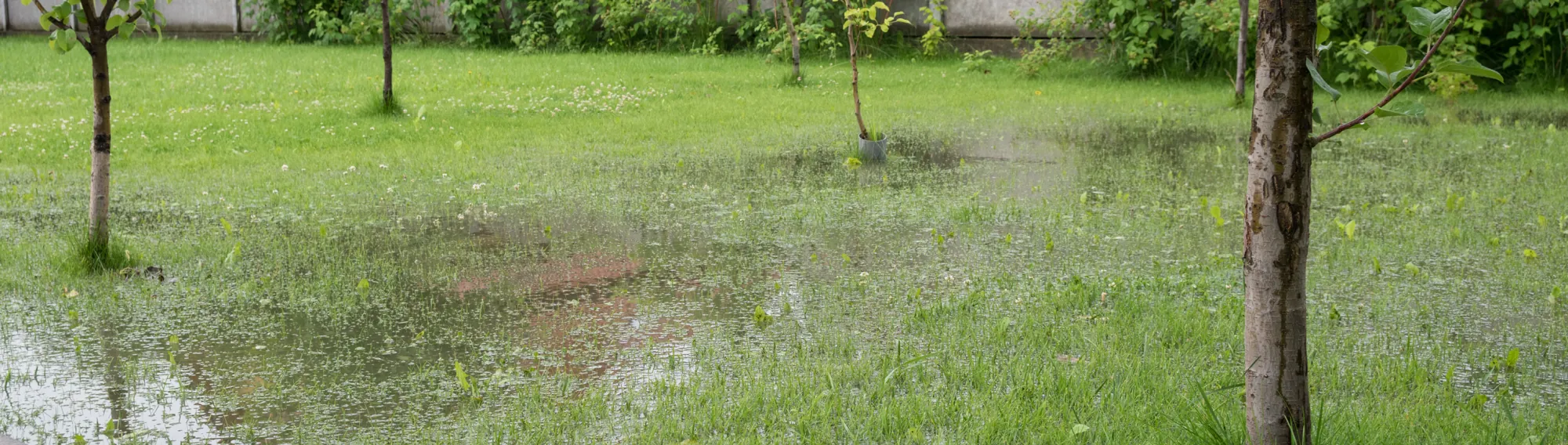
In Azerbaijan, many garden owners still do not take the consequences of excess water and puddling seriously enough. However, water accumulation in the soil can damage your garden and buildings much sooner than you might expect.
In this article, we will explain in detail the importance of a drainage system, the main risks, common mistakes, different types of drainage, and practical recommendations for garden owners.
Excess water in the soil is not just about surface puddles. The main danger begins in the deeper layers: roots suffer from oxygen deficiency, soil structure deteriorates, and as a result, plant health declines. In regions such as Baku and Absheron, just 2–3 weeks of high humidity can lead to the mass die-off of ornamental and fruit trees.
According to research, root diseases spread within the first 3 years in 60% of gardens without a drainage system or with poorly installed systems.
A well-planned drainage system is not a luxury, but an essential requirement for the longevity of your garden and buildings.
A drainage system is an engineered solution designed to divert excess water away from plant roots, buildings, and beneath pathways. It is much more than just a few pipes: it requires soil and terrain analysis, as well as precise calculations for water volume and flow direction.
In Azerbaijan, drainage is especially crucial for clay and clay-sandy soils, as well as areas with high groundwater levels. Even if a plot appears dry in summer, conditions can change dramatically in spring and during rainy periods.
Common mistakes we encounter in practice include: randomly dug trenches, pipes without proper slope, and incorrect backfilling – all of which reduce the effectiveness of drainage and can even worsen the situation.
The type of drainage depends on soil composition, plot size, terrain, and the assets you wish to protect. The most commonly used options are:
For the best results, we usually recommend combined solutions: for example, French drains along paths and deep pipes in orchards. This approach protects your garden even during heavy rainfall.
Many garden owners try to solve drainage issues with simple methods: digging a trench around the perimeter or laying a pipe, but they overlook key technical details. This often leads to drainage failure or even larger problems down the line.
At Sulama, every project begins with an analysis of soil permeability and hydrological calculations. This approach reduces costs and minimises risks in the long term.
A properly installed drainage system can serve your garden for years, but it still requires regular maintenance. Our main recommendations:
If you notice signs of disease in your plants or waterlogging in your garden, consult a specialist promptly – problems can be resolved quickly and without extra expense.
A drainage system is an investment in the health of your garden and buildings. Mistakes made during design can prove costly later. The Sulama team uses modern soil analysis methods and water flow modelling to select the optimal materials and solutions.
We offer a comprehensive service: from site diagnostics and design, to installation and seasonal maintenance. This approach prevents problems before they arise and ensures the system's longevity.
Our experience shows that a properly installed drainage system can operate for 20 years or more without major repairs, keeping your garden healthy even after extreme rainfall.
Signs include puddles after rain, root rot, moss and fungal diseases, and cracks in paths or foundations. If you notice any of these, it is time to consider a drainage system.
It is technically possible, but without soil analysis, slope calculations, and the right material selection, the system will not be effective. For best results, we recommend professional support.
At least twice a year – inspections and cleaning should be carried out in spring and autumn. Additional checks are advisable after heavy rainfall or construction works on site.
Depending on the site and system type, installation usually takes from 3 to 10 days. It is important to pay attention to each stage.
The choice depends on soil type, terrain, and groundwater level. The optimal solution can only be determined through site analysis and expert consultation.